Islam
الإسلام
"Lo! religion with Allah (is) The Surrender (to His will and guidance). Those who (formerly) received the Scripture differed only after knowledge came unto them, through transgression among themselves. Whoso disbelieveth the revelations of Allah (will find that) Lo! Allah is swift at reckoning"[Quran;3:19] "And whoso seeketh as religion other than the Surrender (to Allah) it will not be accepted from him, and he will be a loser in the Hereafter"[Quran;3:85] "And who forsaketh the religion of Abraham save him who befooleth himself? Verily We chose him in the world, and lo! in the Hereafter he is among the righteous. When his Lord said unto him: Surrender! he said: I have surrendered to the Lord of the Worlds. The same did Abraham enjoin upon his sons, and also Jacob, (saying): O my sons! Lo! Allah hath chosen for you the (true) religion; therefore die not save as men who have surrendered (unto Him). Or were ye present when death came to Jacob, when he said unto his sons: What will ye worship after me? They said: We shall worship thy God, the God of thy fathers, Abraham and Ishmael and Isaac, One God, and unto Him we have surrendered.[Quran:2:130-134]"And they say: Be Jews or Christians, then ye will be rightly guided. Say (unto them, O Muhammad): Nay, but (we follow) the religion of Abraham, the upright, and he was not of the idolaters. (Muslims): We believe in Allah and that which is revealed unto us and that whichas revealed unto Abraham, and Ishmael, and Isaac, and Jacob, and the tribes, and that which Moses and Jesus received, and that which the Prophets received from their Lord. We make no distinction between any of them, and unto Him we have surrendered"[Quran;2:135-136]

Islam is the major world religion, the revival of original monotheistic faith of Abraham, through the last Prophet Muhammad (peace be upon him) from Arabia in the early 7th century AD. The Arabic word Islam means “submission”, surrender, —specifically, submission to the will of the one God, called Allah in Arabic. Islam is a strictly monotheistic religion, and its adherents, called Muslims, regard the Prophet Muhammad (peace be upon him) as the last and most perfect of God’s messengers, who include Adam, Abraham, Moses, Jesus, and others. The sacred scripture of Islam is the Qurān, which contains God’s revelations to Prophet Muhammad (peace be upon him). The sayings and deeds of the Prophet recounted in the Sunnah are also an important source of belief and practice in Islam. The religious obligations of all Muslims are summed up in the Five Pillars of Islam, which include belief in God and his Prophet and obligations of prayer, charity, pilgrimage, and fasting. The fundamental concept in Islam is the Sharīāh, or Law, which embraces the total way of life commanded by God. Observant Muslims pray five times a day and join in community worship on Fridays at the mosque, where worship is led by an imam (prayer leader). Every believer is required to make a pilgrimage to Mecca, the holiest city, at least once in a lifetime, barring poverty or physical incapacity. The month of Ramadan is set aside for fasting. Alcohol and pork are always forbidden, as are gambling, usury, fraud, slander, and the making of images. In addition to celebrating the breaking of the fast of Ramadan. The EĪd al-Aḍḥā festival inaugurates the season of pilgrimage to Mecca. The sacrifice of an animal is offered to revive the incidence of Abraham offering his eldest son Ishmael for the sacrifice at Makkah. Muslims are enjoined to defend Islam against unbelievers through jihad, a struggle through peaceful means or warfare against oppression or in defence. Divisions occurred early in Islam, brought about by disputes over the succession to the caliphate. About 90% of Muslims belong to the Sunnite branch. The Shīites broke away in the 7th century and later gave rise to other sects, including the Ismāīlīs. Another significant element in Islam is the mysticism known as Sufism. Since the 19th century the concept of the Islamic community has inspired Muslim peoples to cast off Western colonial rule, and in the late 20th century fundamentalist movements threatened or toppled a number of secular Middle Eastern governments. There were more than 1.5 billion Muslims in the world.
~~~~~~~~~~~~~~~~~~~~~~~~~~~~~~~~~~~~~
What is not demanded by Islam!
- Islam does not demand form a Muslim to give up the world altogether.
- Islam does not expect Muslims (men and women) to be ignorant, lacking in knowledge of their faith and other branches of knowledge.
- Nor does it require one to make the mosque a permanent abode, never to leave it.
- Islam also does not insist that one should live in a cave or monastery and spend his whole life there —- NOT AT ALL.
What islam expects from the Muslims!
- To dwell in their best civilization and matchless culture in a manner that they surpass all the civilized nations of the world.
- They should be the most prosperous of all as far as the different branches of knowledge are concerned.
- Invite the humanity towards Islam, by conveying the message with wisdom, peacefully, in a logical and convincing way. They should argue with them in ways that are best and most gracious.
- Do not use coercion against non Muslims for conversion to Islam.
- The right of retaliation, granted against injustice or oppression is to be used with equity,forgiveness and patience is however preferable.
- Not to kill the innocent people of any faith (including own self-suicide) except by law, they don’t have to create mischief on earth by creating anarchy or disturbing the peace.
- Warfare against injustice and oppression and in self defense is permissible, to be declared by the Islamic State but the rules laid down for its conduct by Shari’a (Islamic Law) be strictly adhered to. Those who surrender or do not fight or remain neutral are not to be disturbed. The prisoners are to protected and provided peace and security.
- Fulfill all bilateral and international accords (like UN Charter) for peace and stability of humanity.
- To treat all members of society with equality fairness and justice.
- Non Muslims in the Islamic society enjoy complete protection and freedom to practice their faith.
- The places of worship of other religions are to be protected.
- Do not abuse or degrade the god/ gods of non Muslims.
QUESTION arises that, if this is what is Islam all bout? Then; what should it be called which is happening in the world at present in the name of Islam?
It’s a complex issue. Please PONDER and find your answers, the books and articles at the web sites/blogs mentioned here, may facilitate you in this endeavour.
~~~~~~~~~~~~~~~~~~~~~~~~~~~~~~~~~~~~~~~~~~~~~~~~~
Islam in Brief
[Translation form extracted from Arabic book "A General Introduction to Islam" by Shaikh Ali Tantawi]
Once I asked my students the following question: “If a non Muslim asks you to explain all about Islam in an hour, what you would do?” This is how they responded: “That: would be impossible! He would have to study the principle of the Oneness of God, commentaries on the Holy Qur’an – and he’d have to learn how to recite from the Holy Qur’an, study the Hadith (sayings of Prophet Muhammad (peace be upon him), the system of Islamic law. He’d also need to delve into problems and issues which could take him fifty years’ I retorted by saying, “Glory be to God! What about the simple and uneducated Bedouin who came to our Prophet and learned all about Islam Just by staying in his company for a day – or even less? And didn’t those very same Bedouin then carry the message of Islam to the desert folk, and in turn become their teachers and guides? Don’t you remember how our Prophet explained our religion in three brief sentences? He spoke about Iman (faith) Islam (the religion) and Ihsun (Man’s realization of his relation to God). So why is it, then, that we can’t explain our religion in an hour in this day and’ age?” So what is Islam – and how does one become a Muslim?
What is Islam? How to be a Muslim?
Pre-requisites of Joining a Group or Association: Every creed, whether its basic principles are based on truth or falsehood, every society, good or bad, and every political party, regardless of whether its intentions are noble or not, operate on certain basic principles and precepts that define its goal and outline its course of action. These principles and precepts are put together in the form of a constitution to guide its members and followers. Anyone wishing to become a member of such an organisation would need to start off by studying these guidelines. If he finds that they satisfy both his conscious and subconscious mind, and believe without any doubt in their validity, he will decide to Join that organisation and become one of its members and supporters.
From then on he has to obey the laws laid down in the constitution and to pay the membership fee. He also has to prove, in due course, his genuine commitment to the principles and precepts of the organisation. This means he has to remind himself of them constantly and make sure he does nothing to contradict them. He has to set an example, through his character and behaviour, of one who ardently follows and supports those principles. So we can say that membership to a society means:
- Knowledge of its system.
- Belief in its principles.
- Adhering to its regulations.
- Conducting oneself in everyday life according to those principles and regulations.
These are accepted conventions which are all applicable to Islam.
Fundamental Principles to Embrace Islam:
Anyone wishing to embrace Islam has to accept its intellectual principles with total conviction right from the start. This means he will have developed the faith within himself. The principles he has to accept are outlined briefly as follows:
- This material world is not the ‘all’ and ‘end of all’ of existence and life in this world is only a part of the eternal life.
- Man existed even before he was born and will continue to exist after death; he did not create himself but had been created before he was conscious of his human existence.
- The inanimate objects around him couldn’t have created him, as he is a rational being and they are not; * everything in this universe has been created from nothingness by the one God, God the Almighty.
- God is the only one who grants life and causes death. It is He who created everything, and if He wishes. He will destroy and obliterate it.
- Almighty God does not resemble His creation in any way. He existed before this creation and He is eternal and has unlimited knowledge.
- He is completely just in a way that cannot be assessed in human terms; it is He who has laid down what we call the laws of nature.
- He has created everything according to a well-defined measure before all creation, thus all the phenomena of activity, inactivity, consistency and inconsistency that we can observe in both animate and inanimate beings have been clearly defined and distinct boundaries have been set.
- Man has been bestowed with the power of intellect to deal with whatever matters he is presented with and he has been given the power of reasoning with which he can make his own choice and will power to enable him to achieve what he wants.
- God has created an eternal life beyond this temporary life, where the doer of good will be rewarded with a life in paradise and the wrong doer will be punished and exist in hell. This God is One. No one else may be worshipped but Him; no one can take us nearer to Him to plead on our behalf without His permission. Thus we should worship God alone, in all sincerity and purity.
- All the material beings that we can see and feel which have been created by Him. He has also created unseen beings, some animate and others inanimate, which we cannot see. Among the unseen beings are the angels, who have been created for absolute good; and then there are the Satans, who have been created as dark and negative forces.
- Apart from these there is a third category of unseen beings, the jinn, who are divided into Satans and ‘good’ or ‘obedient’ jinn and from amongst human beings.
- God selects certain people to whom the Shari’a (Divine Law) is revealed, so that they can guide humanity towards it, these people are the prophets.
- This divine law is contained in all the books revealed from the God. God takes us through progressive “steps” in each book until the final book, the Holy Qur’an. Books that preceded it were either distorted or got lost and forgotten. The Holy Qur’an, however, has remained intact. The last of these prophets is Muhammad bin Abdullah, an Arab of the Quraysh tribe. With him there was an end to all the previous divine messages and religions. There has been no other prophet since his time. The Holy Qur’an is the constitution of Islam. Whoever endorses the fact that it has been revealed by God and believes in it completely, is a Mu’min (believer). Iman (faith) in this sense can only be seen by God because human beings cannot penetrate into human hearts and know what is in them. Therefore it is essential, in order to be accepted in the fold of Islam, that a man declare his faith.
Declaration of Faith:
An individual can pronounce his/her ‘faith in Islam’ by pronouncing: “I bear witness that there is no God but Allah and I bear witness that Muhammad is the Prophet of God.” The moment he pronounces this statement of faith he becomes a Muslim and is entitled to all the rights enjoyed by Muslims; he also agrees to perform all the duties (ibadat) enjoined upon him by Islam.
Duties (ibada) of A Muslim:
The ibadat (duties) of a Muslim, are the prescribed forms of worship. There are only a few and they are easy to perform and do not require much effort or exertion. There are four, as outlined below:
I). Salah (Prayer): A Muslim has to pray two rak’ats (prostrations) at dawn, during which time he has communion with his Lord. He asks Him of His goodness and seeks refuge in Him from His punishment. Before making these prostrations, a Muslim has, to perform wudu (ablutions): he washes his face, hands and feet, or takes a bath if he is in a state of ritual impurity. Besides the dawn prayer, he has to pray at four other times four rak’ats at midday; four rak’ats in the afternoon; three rak’ats at sunset; four rak’ats at night: These are obligatory (faradh) prayers, the performing of which will not, on the whole, take more than half an hour per day. There is no particular place or person required for the performance of these prayers, and it is not necessary for a Muslim to have an intermediary when he prays, as he prays directly to his Lord.
II). Fasting (Saum): In a certain month during the year a Muslim has to fast. This is known as the period of Ramadan. Breakfast is consumed before dawn, lunch is taken after sunset, and during the day all Muslims abstain from food and water and must not have sexual intercourse. Ramadan is a month of self-purification for every Muslim when he purifies his body and soul. It is also a month to fulfill the desire to do good and be generous, and to reflect the brotherhood of man in the material life.
III). Zakah (alms): A Muslim has to give 2.5 % of his wealth as alms to the poor and needy. He does this on an annual basis, once his own needs and those of his family have been met. This financial support paid by every Muslim comes as a great source of comfort’ and assistance to the poor, the sick and the needy. It thus helps to alleviate poverty and establishes a form of social security.
IV). Congregations: Islam has arranged certain periodical gatherings for Muslims. They congregate together five times a day to offer prayer. There need be no disruption of work for anyone whatever his trade or profession. Those who miss the congregation can pray at home, though they will, in fact deprive themselves of the joyful reward of praying together in a group. Then there is the weekly congregation on Fridays for Jum’a prayer. This lasts for less than an hour, and it is compulsory for all male Muslims to attend. Besides the above, there are mass congregations held twice a year on the occasion of the two Eids (festivals). Attendance is not compulsory and they last less than an hour. Finally there is the annual world congregation known as the Hajj. It is a kind of mammoth public gathering, held once a year at Makkah. This congregation provides guidance in all aspects: spiritual, physical and intellectual. A Muslim is expected to attend once in his lifetime, but only if he is able to do so. These are the duties and acts of worship enjoined upon every Muslim.
Avoiding Evil Acts:
Apart from the above, abstention from certain modes of behaviour are also deemed as ibadah (worship). These are actions which any sensible person would deplore, such as killing without a valid reason, intruding on the rights of others, aggressive behaviour and all forms of injustice, any kind of intoxication which would affect the brain, adultery, since it destroys honour and dignity and violates the sanctioned form of blood relationship. Other forms of forbidden behaviour include usury, lying, betrayal and deserting any form of military service which seeks to glorify the Divine Writ, making false oaths or producing false witnesses – and, above all, disobedience to one’s parents or dismissing them and neglecting their needs. However, God forgives a Muslim who fails to carry out some of his duties and disobeys some of the Islamic laws but repents and asks for pardon. On the other hand, a Muslim who does not repent will be considered as a rebel, who will be punished in the next world. This punishment will, however, be only temporary and will not be equal to that of a non-believer. As for a Muslim who refuses to acknowledge any basic Islamic principle or belief, rejects his duties and Islamic regulations or denies even the smallest detail outlined in the Holy Qur’an, he will be considered as an apostate deprived of his Islamic identity. Apostasy is similar to a crime of high treason, from the Islamic point of view. Unless a person gives up his un-Islamic beliefs and repents, he will be given a death sentence.
Total Acceptance of Faith-No Hypocrisy:
Faith has to be accepted in totality and, therefore, a denial of any aspect is deemed as a denial of the whole. Therefore, anyone who accepts 99% of the faith but denies 1% is considered an infidel. You may come across Muslims who are nonbelievers. They can be compared with someone who joins a political party or a society, attends all its meetings, pays his subscription – and does whatever is required of a member, but nonetheless refuses to accept its principles and remains unconvinced. It may seem that such a person has joined the party or society simply to find out what’s going on or to create trouble. Such a Muslim is a hypocrite – hypocrisy is defined as “outward profession of faith and concealment of disbelief”. Prophet Muhammad (peace be upon him), used to say that a hypocrite can be recognised in three ways: failure to keep his promise, I lying and betraying anyone’s trust. A hypocrite pronounces statements of faith and performs his religious duties, yet deep and down he remains unconvinced. Such a person may be considered a Muslim by the outside world but not by God, Who knows what is hidden in our hearts and innermost beings.
The Believing Muslim:
One is a believing Muslims if he/she fully believes in the intellectual and theoretical basses of Islam, which are:-
a) Giving full testimony to the existence Allah (God) and declares He has neither associate nor intermediary.
b) Belief in the angels, all Prophets and all revealed Holy Books, including Qur’an.
c) Belief In the destiny.
d) Expression of the statements of faith (Shahada, kalimah).
e) Performance of the obligatory prayers.
f) Fasting in the month of Ramadan;
g) Payment of zakat (alms);
h) Performance of Hajj (pilgrimage) to Mecca once in a lifetime, if this is possible.
i) Abstention from everything that is forbidden by Muslim consensus.
Generally speaking, adhering to the Iman (Faith) is more beneficial to us – we feel better and enjoy tremendous rewards. This is why, even though it may be hard to stick to these laws 100%, we feel better in ourselves if we follow them. Our Prophet Muhammad (peace be upon him) summed up the characteristics of a true Muslim in an eloquent sentence which states the essence of faith and action in a nutshell: “You should worship God as if you can see him.” This means we must strive to be in total awareness of God’s presence all the time. This is the very essence of Islam – to be God conscious in all our actions, whether or not they are serious. God is watching us constantly and is aware of our every move. This is why anyone who is truly God-conscious will obey His laws, and he will not despair either, knowing that God is with him all the time. A person who is strengthened in this way will not need to ask for help from anyone because he can always ask God to fulfill his needs. And, if anyone disobeys God’s laws, as it is in his nature to sin, provided he asks for forgiveness, God will forgive him. This is just a brief introduction to Islam and in to following chapters we shall be looking into all aspects of faith in detail.
A Sinner Muslim:
If a Muslim fails to perform some of his obligations and is remiss in practice or commits some such actions as are forbidden, yet he believes in the liability of all obligations and the impropriety of all unlawful deeds, he will continue to be a Muslim though he will be a sinner. [The concept of Takfeer i.e declaring a non-practicing Muslim, to be ‘apostate’ and liable to be killed; by some extremist groups, calling themselves as ‘True Muslims only’, is rejected.]
~~~~~~~~~~~~~~~~~~~
More:
 .
.

-----------------------------------------------------------------
Islam-The Eternal Faith
The Legacy of Abraham
“Abraham was neither a "Jew" nor a "Christian", but was one who turned away from all that is false, having surrendered himself unto God; and he was not of those who ascribe divinity to aught beside Him.”(Qur’an;3:67);“Abraham "believed God, and it was reckoned to him as righteousness." So you see that it is men of faith who are the sons of Abraham.”(Glatians;3:6-7).“If you were Abraham's children, you would do what Abraham did.” (Jesus, John; 8:39).
Humanity has been blessed with the instincts and intellect to rationally identify and believe in the existence of a Supreme Creator and Sustainer through the signs within and all around. The man endeavors to live the life within the desired parameters to achieve His pleasure, the objective of his creation. The relation of human being to the Supreme Creator and Sustainer (commonly known as God, Allah) that which they regard as holy, sacred, spiritual, or divine, is termed as ‘Religion’. The word ‘religion’ is derived form Latin ‘religio’ means ‘to bind’. Thus the religion is one of the ways of binding the people together through common deity worship and rituals. According to Encyclopedia Britannica; “Religion is commonly regarded as consisting of a person's relation to God or to gods or spirits. Worship is probably the most basic element of religion, but moral conduct, right belief, and participation in religious institutions are generally also constituent elements of the religious life as practiced by believers and worshipers and as commanded by religious teachers, messengers and scriptures.” In Islam the worship, in its true sense is not only restricted to the rituals and dogmas, but it is the complete submission and obedience to the God, to live the life, in all aspects as desired by Him by rejecting evil temptations; a complete social system. All the religions basically have a common origin, the history of religion is summed up by Qur’an: “Mankind were one community, and Allah sent (unto them) Prophets as bearers of good tidings and as warners, and revealed therewith the Scripture with the truth that it might judge between mankind concerning that wherein they differed. And only those unto whom (the Scripture) was given differed concerning it, after clear proofs had come unto them, through hatred one of another. And Allah by His will guided those who believe unto the truth of that concerning which they differed. Allah guides whom He will unto a Straight path.”(Qura’n;2:213). With the passage of time the original message of guidance i.e. to worship and obey one God preached by massagers like Enoch (Idris), Noah (peace be upon them), and others got obscured. However it got revived during 18th century B.C, through Prophet Abraham (peace be upon him), the forebear of the three great religions; Judaism, Christianity and Islam. Over the period, even the original faith of Abraham despite the efforts of messengers among his progeny (like Ishmael, Isaac, Jacob, Moses and Jesus, peace be upon them all) got obscured and corrupted, thus dividing them into sects and groups. The other major world religions like Hinduism also have monotheistic doctrines buried under the dust of polytheistic, idolatrous, mystic and other practices. The sacred Hindu scriptures, urge: “O friends, do not worship anybody but Him, the Divine One. Praise Him alone.”(Rigveda;8:1:1). Buddhism, is considered non committal on God, historical criticism has proved that the original teachings of Buddha can never be known, because his teachings and doctrines were written down 400 years, after his death. Moreover little attention was paid to its authenticity, genuineness and purity. However prophesies of advent of Prophet Muhammad (peace be upon him) in Buddhist scriptures points towards some missing links. The religions differ in their set of principles or beliefs or the body of dogmas commonly called Faith; which is the theological virtue defined as secure belief in God and a trusting acceptance of God's will. Allah says: “In fact, your religion is one religion, and I am your only Lord: so fear Me Alone. Yet people have divided themselves into factions and each faction rejoices in its own doctrines”(Qur’an;23:52-53). This original religion was revived in its unique spirit of monotheism, fourteen hundred years ago in concordance with the light of reason; exclusive of mysterious doctrines to cast a shade of sentimental ignorance round the original truths rooted in the human intellect, representing the latest development of the religious faculties.
Faith:
The ‘faith’, (Greek pistis, Latin fides, Hebrew ‘aman,’ Arabic ‘Ayman’) is the inner attitude, conviction, or trust relating man to a supreme God or ultimate salvation. In religious traditions stressing divine grace, it is the inner certainty or attitude of love granted by God himself. Some inner attitude has its part in all religious traditions, but it is not always of central significance. For example, words in ancient Egypt or ancient (Vedic) India that can be roughly rendered by the general term "religion" do not allow for "faith" as a translation but rather connote cultic duties and acts. In Hindu and Buddhist Yoga traditions, the recommended inner attitudes are, primarily attitudes of trust in the guru, or spiritual preceptor, and not, or not primarily, in God. Hindu and Buddhist concepts of devotion (Sanskrit bhakti) and love or compassion (Sanskrit karuna) are more comparable to the Christian notions of love (Greek agape, Latin caritas) than to faith. Devotional forms of Mahayana Buddhism and Vaisnavism show religious expressions not wholly dissimilar to faith in Christian and Jewish traditions. Notions of religious trust in India, China, and Japan are as a rule different from the notion of faith in Western religions (Judaism, Christianity and Islam). The "trust" (Pali saddha, Sanskrit shraddha) described in the Buddhist Eightfold Path is comparable to the confidence with which a sick person entrusts himself to a physician. The Chinese hsin ("confidence, trust, sincerity") is considered to be one of the five principal virtues.
In biblical, a tradition, the faith is basically based on trust. A thing is true, and therefore worthy of trust. It admits of many degrees up to full assurance of faith, in accordance with the evidence on which it rests: “And “Which made heaven, and earth, the sea, and all that therein is: which keeps truth for ever:”(Psalms;146:6); “O send out thy light and thy truth: let them lead me; let them bring me unto thy holy hill, and to thy tabernacles.” (Psalms;43:3) [Tabernacle: The portable sanctuary in which the Jews carried the Ark of the Covenant through the desert]. In other words, "faith" is principally juridical; it is the faithfulness or truthfulness with which persons adhere to a treaty or promise and with which God and Israel adhere to the Covenant between them; a legacy of Abraham: “And he believed in the LORD; and he counted it to him for righteousness.”(Genesis;15:6); “And Abram fell on his face: and God talked with him, saying, As for me, behold, my covenant is with thee, and thou shalt be the father of a multitude of nations.”(Genisis;17:3-4); “And I will establish my covenant between me and thee and thy seed after thee throughout their generations for an everlasting covenant, to be a God unto thee and to thy seed after thee.”(Genisis;17:7);“Abraham believed God, and it was credited to him as justice.”(Romans;4:3). The Jewish creed is monothisitic in faith: "Hear O Israel, the Lord is our God, the Lord is One” (Deuteronomy; 6:4). The nexus between faith and justice or justification was developed by Paul much later; after Prophet Jesus Christ (peace be upon him). The biblical traditions of the Old Testament maintained the demand of God of the covenant (Exodus;14:312, 19:9, Johua;24, Ishiaha;7:9). The faith is the pledge of salvation (Isiah;28:16, 30:15, Jermiah;17:5, Pslams;52:8-9). Some scholars think that Zoroastrianism, as well as Judaism, may have had some importance in the development of the notion of faith in Western religion. Zoroaster (628-551 B.C) is reported to have spoken of a new, conscious religious choice on the part of man for truth (asha).
In Christian theology, faith is considered to be, the divinely inspired human response to God's historical revelation through Jesus Christ and consequently, is of crucial significance. In the New Testament, faith is above all, faith in Jesus and his mission as perceived by Paul, stated in Nicene Creed (325 C.E): against the original preaching of all previous messengers and Jesus himself.(Mathew;5:17-20, Deuteronomy;6:4, 5:7-9, 6:13-15 & Mark 12:29-30, John; 5:30). In short, the Christian Faith is based upon the belief in; “Trinity, (God, Son and Holy Sprit as One), Jesus as the Son of God, the Lord, Savior, who died at the cross to redeem the sins of humanity and resurrected on third day, ascended into heaven and is seated on the right hand of the Father and the resurrection of the dead”. The faith is interpreted as condition for salvation (Mathew;9:28, Mark;4:36-41, Luke;8:25). Hence in Christianity, the doctrine of ‘Justification by Grace, through Faith’ was developed. It is the belief that a person can achieve salvation only through faith and reliance on God's grace, not through good deeds. The phrase is adapted from a sentence in the epistles of Paul in the Bible:" For by grace are ye saved through faith; and that not of yourselves: it is the gift of God (Ephesians;2:8 ); “Even when we were dead in sins, hath quickened us together with Christ, (by grace ye are saved;)”(Ephesians;2:5). ‘Justification’ is what sets a person fundamentally in friendship with God, and entitles the person to life with God in heaven after death. The passage of an individual from sin to a state of grace has been explained in different ways: Some theologians use the term to refer to the act of God in extending grace to the sinner, while others use it to define the change in the condition of a sinner who has received grace. St. Paul used the term to explain how people moved from sin to grace through the death and resurrection of Jesus and not through any human effort. St. Augustine saw it as an act of God that makes sinners righteous. Whether human beings can contribute to this justification, in addition to God's grace, was one of the great points of division among Christians at the time of the Reformation in 16th century lead by Martin Luther (1483-1546 C.E), the German theologian. His opposition to the wealth and corruption of the papacy and his belief that salvation would be granted on the basis of faith alone rather than by works, was against the common teaching of the Roman Catholic Church that people's good works, as well as their faith, helped to save them. Two of the slogans of Luther were "Grace Alone" and "Faith Alone." Since the time of Luther, the differences between Protestant and Roman Catholic teachings on point have become hard to discern which caused excommunication of Luther from the Catholic Church in 1521 C.E. Luther confirmed the Augsburg Confession in 1530 C.E, effectively establishing the Lutheran Church. The Protestants as they are called, also believe in the acceptance of the Bible as the sole source of revelation and; the universal priesthood of all the believers. The doctrine of Justification by Grace, through Faith’ is in direct conflict to the Jewish position that justification is through good works, by perfectly fulfilling law and not the gracious and gratuitous gift of God only.
In Islam, it is the Faith (Ayman) which sets the believer apart from others, Allah says: “O you who have attained faith! Hold fast unto your belief in God and His Apostle (Muhammad, peace be upon him) and the Scripture which He hath revealed unto His messenger, and the Scripture which He revealed aforetime. Whoso disbelieves in God and His angels and His scriptures and His messengers and the Last Day, he verily hath wandered far astray.”(Qur’an;4:136). It is ascertained that faith is by the grace of God for those who use their reason, God says:” It is not possible for anyone to believe except by the permission of Allah, and He throws filth (of disbelief) on those who do not use their reason. Say: "Look at whatever exists in the heavens and the earth." Signs and warnings do not benefit those people who do not believe.”(Qur’an;10:100-101). In Islam, the faith and good deeds both are required for salvation. Allah, the Most Gracious, the Most Merciful says: “Surely mankind is in loss, except those who attain Faith and do good deeds; exhort one another to the truth and exhort one another to patience.”(Qur’an;103:2-3); “Say: "Shall we Tell you of those who lose Most In of their deeds?-"Those whose efforts have been wasted In This while They thought that They were acquiring good by their works? "They are those who deny the Signs of their Lord the fact of their having to meet Him (in the Hereafter): vain will be their works nor shall We, on the Day of Judgment, give them any weight. That is their reward, Hell, because They rejected and took My Signs and My Messengers by way of jest. As to those who believe and work righteous deeds, have, for their entertainment, the Gardens of Paradise,”(Qur’an;18:103-107). Not any race, or people, or community, or group, should believe that they have exclusive possession of Allah's Grace, or that they can influence its grant or its withholding. Allah's Grace is free, and entirely controlled by Him, independently of any priests and privileged people. He dispenses it according to His own wise and holy Will and Plan; and to His Grace there is no limit. It is up to Him to bestow His Grace upon whom He likes, He says: “…the people of the Book may know that they do not have the sole right to the grace of Allah, and that His grace is entirely in His own hands, which He bestows on whomever He wills: and Allah is the Owner of mighty grace.”(Qur’an;57:29); “Now those who believe in Allah and hold fast to Him, Allah will soon cover them with His mercy and grace and will show them the Right Way to Himself.”(Qur’an;4:175); “He punishes whom He wills and shows mercy to whom He pleases, and to Him you shall be turned back.”(Qur’an;29:21). Mere oral statement of belief is only the first stage, the truthfulness of belief is tested, Allah says: “Do the people think that they will be left alone on saying "We believe," and that they will not be tested? We did test those who have gone before them. Allah has to see (for the purpose of reward and punishment) who are the truthful and who are the liars”.(Qur’an;29:2-3). The Faith (ayman) is achieved through belief and practices, leading to piety (taqwa), Allah says: “Righteousness is not whether you turn your face towards East or West; but the righteousness is to believe in Allah, the Last Day, the Angels, the Books and the Prophets, and to spend wealth out of love for Him on relatives, orphans, helpless, needy travelers, those who ask for and on the redemption of captives; and to establish prayers (Salah), to pay alms (Zakah), to fulfill promises when made, to be steadfast in distress, in adversity, and at the time of war. These people are the truthful and these are the pious.(Qur’an;2:177). The 4th Caliph Ali (599-661 C.E) is attributed to have said; ‘Faith precedes good actions and good actions point towards faith. They compliment and reciprocate each other.’ The Qur’an is the final revelation in which Allah said: "ye are the best community (Ummah) brought forward to mankind."(Qur’an;3:110). So in order to receive His Grace, one has to submit to the Will of God to join the best community of the people of Islam.
Videos: http://faithforum.wordpress.com/videos/ Free Download click this Link: or see embedded book below:-
A Brief & Comprehensive Book on Islam
Video Playlists
Islam is Peace: http://www.youtube.com/playlist?list=PLB9B95C57D174E66B Anti-Islam FAQs: http://www.youtube.com/playlist?list=PLD28811D03B12C6F8 Islam responds to Challenges: http://www.youtube.com/playlist?list=PL5146DC4DB301D55E The World of Islam: http://www.youtube.com/playlist?list=PL57B138935E5C9648 Islam, Christianity & Judaism: http://www.youtube.com/playlist?list=PLEE0F8991C877FEBB Prophet Muhammad (pbuh): http://www.youtube.com/playlist?list=PL0A1E7D4C94E3E5E5
Short link 'Islam-A Perspective': http://wp.me/PCgrB-4C
****************************************************
What is Islam? http://wp.me/PCgrB-a3
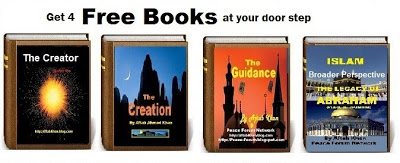
To Get set of 4 Basic books [Creator, Creation, Guidance Islam: Broader Perspective] totally FREE at your doorstep [within Pakistan], send name and complete postal address via e mail: faithforum@live.com or SMS @ +92300-4443470
For further in-depth study:-
******************************************
Short Introduction to 4 Basc Books
The Creator: Is there a God?
The idea of a Supreme Power who is the First Cause of all things, the Creator and Ruler of heaven and earth has always been part of human nature from the beginning. The belief on God was followed by His worship in different cultures. The relation of a group of human beings to God or the gods or to whatever they consider sacred or, in some cases, merely supernatural is known as religion. The beliefs supporting the existence of God or against it, including the middle positions have resulted in an array of doctrines, the most prominent among them are; Theism, Monotheism, Theodicy, Deism, Agnosticism and Atheism. The main issue which have remained the center of attention of believers of the God has been; How to prove the existence of God rationally? Dilated upon in this book. The Abrahamic religions e.g., Judaism, Christianity, and Islam attempt to satisfy human quest through the Revealed knowledge received by the prophets and messengers of God. While exploring the historic development in theosophical and scientific aspects about ‘The God’ and ‘The Creation’ specifically in the three religions linked to Abraham. Islam emerges as true legacy of Abraham contrary to the common perception that it was a new religion founded by Prophet Muhammad (peace be upon him). Does God really exist? Find out more, click 'The Creator'
The Creation: Why do we exist?
Man has always been inquisitive about the origin and creation of universe to which earth is just a small part. The whole cosmic system of matter and energy is called universe. Its main constituents are the galaxies, within which are stars and stellar groupings and nebulae. Earth’s Sun is one star among the billions of stars in the Milky Way Galaxy.The book “The Creation” includes the traditional narratives and myths of Creation, Scientific & theosophical theories, The Grand Design, Qur’anic and Biblical narrative of creation; Comparative analysis. Synthesis of Islamic & scientific narrative of creation. Human creation; Origin of life, Theory of Evolution and Refutation by Christians; Islamic perspective. Click.. The Creation
The Guidance: Does human need to be guided? If so, how?
It is said that human is a thinking, rational animal. He knows what is right and what is wrong, so does he/she need some additional source of Guidance? Some say ‘No’, while others say ‘Yes’ and still there are who say ‘I Don’t know’. The Book “Guidance” includes, natural guidance, miracles & signs; The brief on the messengers of God; from Adam – Noah – Abraham – Ishmael – Isaac – Jacob -Moses – David, Solomon - John The Baptist (peace be upon them all), Prophet Jesus Christ, The Son of Mary (peace be upon him) and The Last Messenger; Muhammad (peace be upon him). The Sacred Scriptures. i.e. The Bible and Qur’an have been briefly introduced. Find out more, click Guidance
Islam, Broader Perspective: Legacy of Abraham:
Humanity has been blessed with the instincts and intellect to rationally identify and believe in the existence of a Supreme Creator and Sustainer through the signs within and all around. The man endeavors to live the life within the desired parameters to achieve His pleasure, the objective of his creation. This original religion was revived: Islam, in its unique spirit of monotheism, fourteen hundred years ago in concordance with the light of reason; exclusive of mysterious doctrines to cast a shade of sentimental ignorance round the original truths rooted in the human intellect, representing the latest development of the religious faculties. The Book “Islam: The Broader Perspective”;includes the Islam of Prophet Abraham, refutation of Prophet Jesus Christ by Jews, evolution of Christianity, revival of Legacy of Abraham (pbuh) by Prophet Muhammad (pbuh). Its doctrines, practices and the concept of Predestination has been debated. The other subjects include; Jihad, Shari’a , Priesthood, Human Rights and role of Islamic civilization in the development of humanity and the modern challenges. For details please download and read the book, click here >> Islam, Broader Perspective
- Theology
- The Creator
- The Creation
- The Guidance
- The Ultimate Faith & Way of Life
- The Perpetual Way
- Abraham to Judaism
- Jesus Christ & Christianity
- Islam-Revived Legacy of Abraham
- Islam-Doctrines, Practices
- Pillars of Faith
- Jihad
- Predestination
- The Law & Bible
- Shari’a: The Islamic Law
- No Priesthood
- Universal Faith
- Human Rights
- Contributions of Islamic Civilization in Development of Humanity
- The Paradox
- The Broader Perspective
- Conclusion
- Islam
- The Last Prophet
- The Real Islam
- Choosing A Course
- What is Islam?
- Doubt, Presumption, Knowledge
- Principles of Coceptualization of Faith
- Faith in One God
- Manifestation of Faith
- Faith in Predestination
- Faith in Unseen [Metaphysics]
- Faith in Pophets
- Miracles of Prophet Muhammad (pbuh)
- Faith in Holy Scriptures
- The Holy Qur’an
- The Epilogue
- Knowledge and Learning
- Impact of Islam on Christianity & West
- Caliphate
- Sectarianism
- Shiaism
- Jihad
- Philosophy
- Four books [Creator, Creation, Guidance, Islam-Broader Perspective] can be obtained totally FREE at your doorstep [within 15 days in Pakistan], by sending name and complete postal address via: SMS@+92300-4443470Read brief introduction to these books <<here>>